

Table of Contents
- Why Your Electric Scooter Battery Ages Faster Than It Should
- How to Charge Electric Scooter Battery Correctly
- Electric Scooter Battery Storage Tips for Long-Term Inactivity
- Signs of a Failing E-Scooter Battery
- How Cold Weather Affects Battery Health and How to Recover Range
- What the BMS Does and Why Calibration Cycles Matter
- Riding Habits, Cleaning, and Maintenance Schedule That Protect Capacity
- Safety Protocols for Damaged or Overheating Batteries
- Protecting Your Pack Starts With the Right Scooter
- Frequently Asked Questions
Last Updated: October 2, 2026
Why Your Electric Scooter Battery Ages Faster Than It Should
Most riders blame the battery when range drops. The real culprit is usually how it gets charged, stored, and ridden.
An electric scooter battery is a lithium-ion pack that loses capacity every time it sits at full charge, drains to zero, or bakes in a hot car. Those losses are permanent. The good news: they are also mostly avoidable.
At Next Pair Rides, we see the same pattern in warranty questions. Riders who follow three simple habits get years of usable range. Riders who don't often replace packs early.
This guide covers how to maintain electric scooter battery for longevity, from charge limits to cold weather to what the BMS actually does.
Below, we'll show you exactly how to charge, store, and ride so your pack keeps its capacity.
How to Charge Electric Scooter Battery Correctly
Charge to about 80% for daily rides and only go to 100% before a long trip. That single habit slows the chemical wear that causes capacity loss.
Lithium-ion cells age fastest at the extremes: near 100% and near 0%.
The 20-80 Rule and Why Full Charges Wear Cells Down
A full charge pushes cell voltage to its maximum. That high voltage speeds up battery degradation inside the pack. Keep the pack between 20% and 80% and the cells sit in a gentler range.
The trade-off is real: you give up some range today to keep more range next year. For most commuters, 80% covers the daily trip anyway.
Charging Frequency, Trickle Charging, and When to Unplug
Charge when the pack drops to around 20%, not after every short ride. Unplug once the charger light turns green. Leaving a charger connected for hours adds heat and stress for no benefit.
Also avoid charging right after a hard ride. Let the pack cool for 30 minutes first.
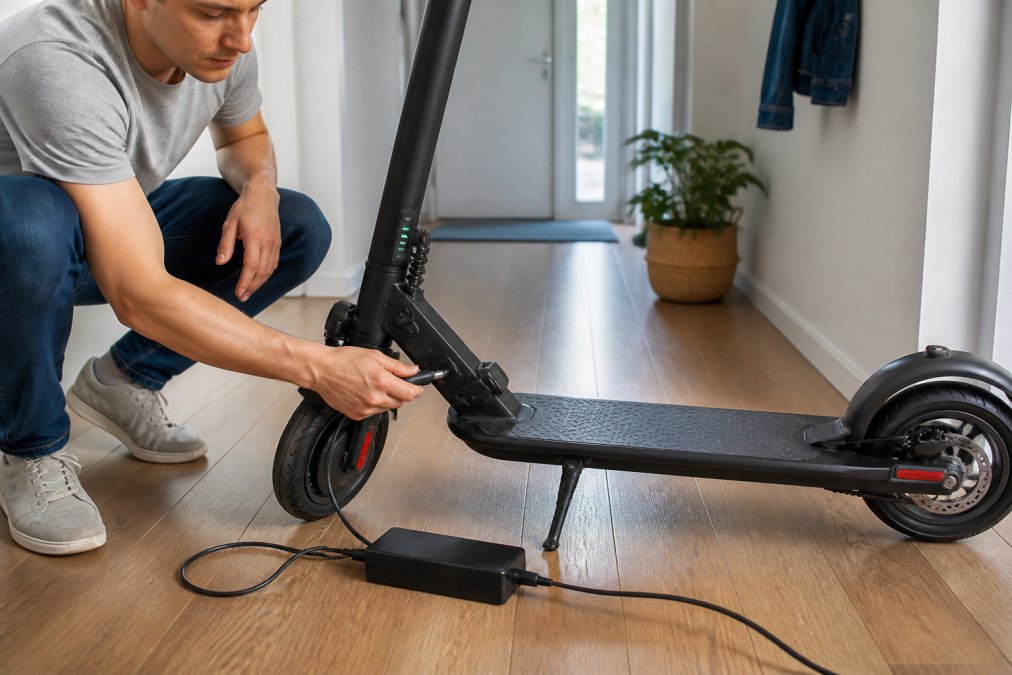
Electric Scooter Battery Storage Tips for Long-Term Inactivity
For storage longer than two weeks, leave the pack at roughly 50% to 60% and keep it in a cool, dry spot. A full or empty pack degrades faster while it sits.
Storage Voltage, Ambient Temperature, and Shelf Life
Storage voltage is the charge level a pack holds while unused. Around half charge is the sweet spot.
- Avoid garages that swing from freezing to hot
- Keep the scooter out of direct sun
- Check the charge every 4 to 6 weeks and top it back to about 50%
- Never store a pack at 0%
Cold slows the battery chemistry and cuts usable capacity. Heat does the opposite: it speeds up capacity loss permanently.
Signs of a Failing E-Scooter Battery
A failing pack shows up as shrinking range, faster voltage sag under load, and a scooter that dies on hills it used to climb. These signs point to capacity loss, not a charger problem.
Watch for these signs of a failing e-scooter battery:
- Range drops sharply versus a few months ago
- The display falls fast under acceleration
- The pack gets unusually hot while charging
- Charge time shortens or the light never turns green
- The scooter shuts off under load
If you see swelling, a chemical smell, or overheating, stop using the scooter.
DriveTron DT06 Dual-Motor Electric →
How Cold Weather Affects Battery Health and How to Recover Range
Cold weather cuts range because the pack's internal resistance rises. The capacity is still there. It just can't flow as easily. Most guides stop there. The real gap is that winter storage and winter riding need different protocols, and mixing them up is what causes permanent damage.
Winter Riding Protocol
Ride with a warm pack whenever possible. Charge indoors at room temperature, then ride within an hour or two while the cells are still warm. A pack charged in a freezing garage will accept less energy and deliver less range even at 100%.
Winter Storage Protocol
For storage longer than two weeks in cold weather, leave the pack at 50-60% and keep it indoors, not in a freezing garage or shed. Cold storage at 50% is actually gentler on cells than warm storage at 50%, but only if the pack never freezes. A frozen pack can suffer permanent lithium plating if charged before it thaws.
Recovery When Temperatures Rise
Range usually returns as temperatures rise. Permanent loss only happens if you charged a frozen pack or stored it at full charge in the cold. If range does not recover by late spring, the pack may have suffered cold damage or simply aged. A calibration cycle can confirm whether the BMS estimate is off or the capacity is truly gone.
What the BMS Does and Why Calibration Cycles Matter
The BMS, or Battery Management System, is the circuit board that protects the pack. It balances cells, caps charge and discharge, and shuts the pack down before damage. Most riders never think about it, but understanding the BMS explains why some battery habits matter more than others.
Why Overcharging Is Less Risky Than Deep Discharge
A common fear is leaving the scooter plugged in too long. In practice, a functioning BMS stops charge current once the pack reaches its maximum voltage. That is why overcharging is less of a risk than deep discharge. The BMS cannot stop you from draining the pack to 0% while riding, and it cannot undo the damage of leaving a pack at 0% for weeks.
What the BMS Actually Monitors
A typical e-scooter BMS tracks:
- Cell voltage, to prevent any single cell from overcharging or over-discharging
- Pack temperature, to cut power if the pack gets too hot
- Charge and discharge current, to prevent overload
- State of charge, to estimate remaining range
The state-of-charge estimate is the weakest link. It drifts over time because the BMS calculates it from voltage and current, not from a direct measurement of capacity. That drift is why calibration cycles matter.
When and How to Calibrate
A calibration cycle resets the BMS's estimate of remaining charge. Over time, that estimate drifts. The display may show 30% when the pack is nearly empty.
To calibrate:
- Charge to 100% and leave it plugged in for an hour after the light turns green
- Ride until the scooter's low-voltage cutoff stops it
- Charge straight back to 100%
Riding Habits, Cleaning, and Maintenance Schedule That Protect Capacity
Your riding habits shape battery life as much as charging does. Hard acceleration and top-speed runs pull high current, which heats the pack and speeds up battery degradation.
| Task | How Often | Why It Matters |
|---|---|---|
| Check charge level | Weekly | Prevents deep discharge |
| Clean charging port | Monthly | Stops corrosion and poor contact |
| Inspect terminals | Monthly | Catches loose or dirty connections |
| Calibrate the BMS | Every 3-4 months | Keeps range estimate accurate |
| Full storage check | Every 4-6 weeks | Protects packs left unused |
Safety Protocols for Damaged or Overheating Batteries
Stop riding the moment a pack shows damage. Physical dents, water exposure, or a hot pack all raise the risk of thermal runaway, a chain reaction that can't be stopped once it starts.
Follow these steps:
- Turn the scooter off and move it away from buildings
- Do not charge the pack
- Place it on a non-flammable surface, ideally outdoors
- Watch for swelling, smoke, or a sweet chemical smell
- Contact the seller or a local battery recycler for disposal
Protecting Your Pack Starts With the Right Scooter
Battery care rewards patience. Charge to 80%, store at half, avoid deep discharge, and keep the pack cool. Those habits add years to any pack.
Frequently Asked Questions
How to make your electric scooter battery last longer?
Keep the charge between 20% and 80% for daily riding, avoid draining to 0%, and store the scooter at around 50-60% if you won't ride for weeks. Charge at room temperature rather than in a cold garage, and unplug once the charger indicator shows full. These habits slow capacity loss and extend the useful life of the lithium-ion cells.
What is the average lifespan of an electric scooter battery?
Most lithium-ion packs are rated for several hundred charge cycles before capacity drops noticeably. How you treat the battery matters more than the calendar: partial charges, moderate ambient temperatures, and avoiding deep discharge all push you toward the upper end of that range. A pack that is regularly run to 0% or left plugged in for days will lose capacity sooner.
What happens if an electric scooter is not used for a long time?
A battery left at full charge or at 0% for months degrades faster than one stored at a partial charge. For long-term storage, bring the pack to roughly 50-60%, keep it in a dry spot at moderate ambient temperature, and check the voltage every few weeks. If it drifts below 30%, top it back up to the storage range.
Does cold weather affect electric scooter battery health?
Cold temperatures temporarily reduce usable capacity and can make the scooter feel slower, but the effect is usually reversible once the pack warms to room temperature. Charge indoors in winter, let the battery reach normal temperature before riding hard, and expect shorter range on cold commutes. Never charge a frozen pack straight away.