

Table of Contents
- Quick Comparison: Electric Scooters for College Campuses
- DriveTron DT01: Budget-Friendly Entry Point for Short Campus Rides
- DriveTron DT08: Balanced Performance for Mid-Size Campuses
- DriveTron DT10: Long-Range Power for Large Campus Networks
- Electric Scooter Range for Commuting: Real-World Campus Distance
- Lightweight Electric Scooter for College: Portability Between Classes
- Electric Scooter Campus Rules and Safe Riding Practices
- Electric Scooter vs Car Cost for College: Total Ownership Breakdown
- Frequently Asked Questions
Last Updated: October 7, 2026
Quick Comparison: Electric Scooters for College Campuses
Choosing the right electric scooter college campus option comes down to three core factors: how far you need to travel between classes, how much you're willing to carry, and what your campus rules actually allow.
Most students make one of two mistakes. They either buy something too heavy to carry up stairs (defeating the whole purpose of campus mobility), or they pick a scooter with range that sounds good on paper but falls short when you're navigating hills, crowded paths, and real-world weather. The three DriveTron models we carry address these trade-offs directly.
| Model | Motor Power | Top Speed | Range | Weight | Best For |
|---|---|---|---|---|---|
| DriveTron DT01 | 400W | 19 mph | 19-25 miles | 40.8 lb | Short campus rides, budget-conscious |
| DriveTron DT08 | 500W | 25 mph | 25-37 miles | 48.5 lb | Mid-size campuses, balanced performance |
| DriveTron DT10 | 1200W | 34 mph | 28-40 miles | Varies | Large campuses, hills, longer commutes |
Below, we'll walk you through each model and cover the campus-specific factors that actually matter: real-world range, portability between classes, campus regulations, and total cost of ownership. By the end, you'll know exactly which scooter fits your commute.

DriveTron DT01: Budget-Friendly Entry Point for Short Campus Rides
The DriveTron DT01 is the right choice if your campus is compact and you're commuting short distances between classes. Its 400W motor and 36V 10.4Ah battery deliver a manufacturer-rated range of 19-25 miles per charge, more than enough for most students who ride just a few miles daily.
What makes this model stand out for college use: it weighs 40.8 pounds and folds for easy storage in a dorm room or locker. You can actually carry it up stairs without struggling. The 10-inch tubeless tires handle campus pathways well, and the electronic braking system paired with a front disc brake gives you reliable stopping power in crowded areas where pedestrians are everywhere.
The trade-off is speed and power. At 19 mph top speed, you're moving faster than walking but slower than a bike. On flat ground with an average-weight rider, expect closer to the lower end of that 19-25 mile range. Hills will cut into your range noticeably, and heavier riders will see performance drop.
At $449.99, the DT01 is the most affordable electric scooter for college campus use. If you're testing whether scooter commuting works for you, this is the lowest-risk entry point. Many students upgrade later, but plenty find this model handles their entire college experience without compromise.
DriveTron DT08: Balanced Performance for Mid-Size Campuses
The DriveTron DT08 steps up to a 500W motor and delivers 25-37 miles of range per charge. It's the sweet spot for students whose campuses are larger or whose daily commute includes longer distances between class clusters.

The aluminum-alloy frame keeps the weight manageable at 48.5 pounds, still portable enough to carry between buildings, though noticeably heavier than the DT01. The 25 mph top speed gets you across campus faster, which matters when you have 10 minutes between lectures. Charging takes 4-6 hours, so you can top up during study sessions or overnight.
The real advantage here is reliability under real-world conditions. The DT08 handles mild hills better than the DT01, and the extra motor power means less performance loss for heavier riders or in windy conditions. The 10-inch tubeless tires are the same as the DT01, so durability and maintenance are comparable.
At $549.99, the DT08 costs $100 more than the DT01 but delivers noticeably better performance for mid-sized campuses. If your campus is more than a mile end-to-end, or if you're carrying textbooks and a backpack, the extra range and speed justify the investment.
DriveTron DT10: Long-Range Power for Large Campus Networks
The DriveTron DT10 Single Motor combines a 1,200W motor with a 52V 18Ah battery, 10-inch tubeless tires, and front and rear suspension. It delivers 28-40 miles of range and 34 mph top speed.

This model handles hills without performance loss. The dual braking system gives you confidence in crowded campus areas where sudden stops matter. Front and rear suspension absorbs bumps on uneven sidewalks and grass shortcuts, common on large campuses.
The trade-off is weight and price. At $749.99, this is a serious investment. You'll need to plan storage carefully, it's not as portable as the lighter models. But if your campus is genuinely large, or if you're commuting between satellite campuses or off-campus housing, the range and power eliminate range anxiety entirely.
Electric Scooter Range for Commuting: Real-World Campus Distance
The manufacturer-rated range on any electric scooter assumes ideal conditions: flat terrain, average rider weight, moderate temperature, and smooth surfaces. Campus reality is different.
Real-world range typically runs 15-20% lower than rated specs, depending on these factors:
Rider weight is the biggest variable. A 200-pound rider will see noticeably shorter range than a 150-pound rider on the same scooter. The DriveTron models support up to 265 pounds, but heavier riders should expect the lower end of the range estimate.
Terrain matters more than most guides admit. If your campus has hills, you'll lose range faster. A 25-mile rated range might become 18-20 miles if you're climbing elevation regularly. The DT10's extra power handles hills better, but even it will show range loss on steep terrain.
Weather affects battery performance. Cold temperatures reduce range by 10-15%. Hot weather (above 85°F) can also reduce range slightly, though lithium batteries in the DriveTron models are more stable than older chemistries.
Your riding style matters. Constant acceleration and hard braking drain the battery faster than steady cruising. Campus commuting involves frequent stops at crosswalks and pedestrian areas, so budget for that inefficiency.
For a typical student at a mid-size campus, the DT08's 25-37 mile range means you'll realistically see 20-30 miles per charge. That's enough for most daily commutes with room for evening trips around campus.
Lightweight Electric Scooter for College: Portability Between Classes
This is where many students compromise poorly. They buy a scooter with great range but can't actually carry it, so they leave it parked and walk anyway, defeating the entire purpose.
DriveTron DT01 Electric Scooter – 400W, 36V 10.4Ah →
The DriveTron DT01 at 40.8 pounds is genuinely portable. Most students can carry it one-handed for short distances or two-handed up a flight of stairs. The folding design makes it compact enough to fit in a dorm closet or under a bed.
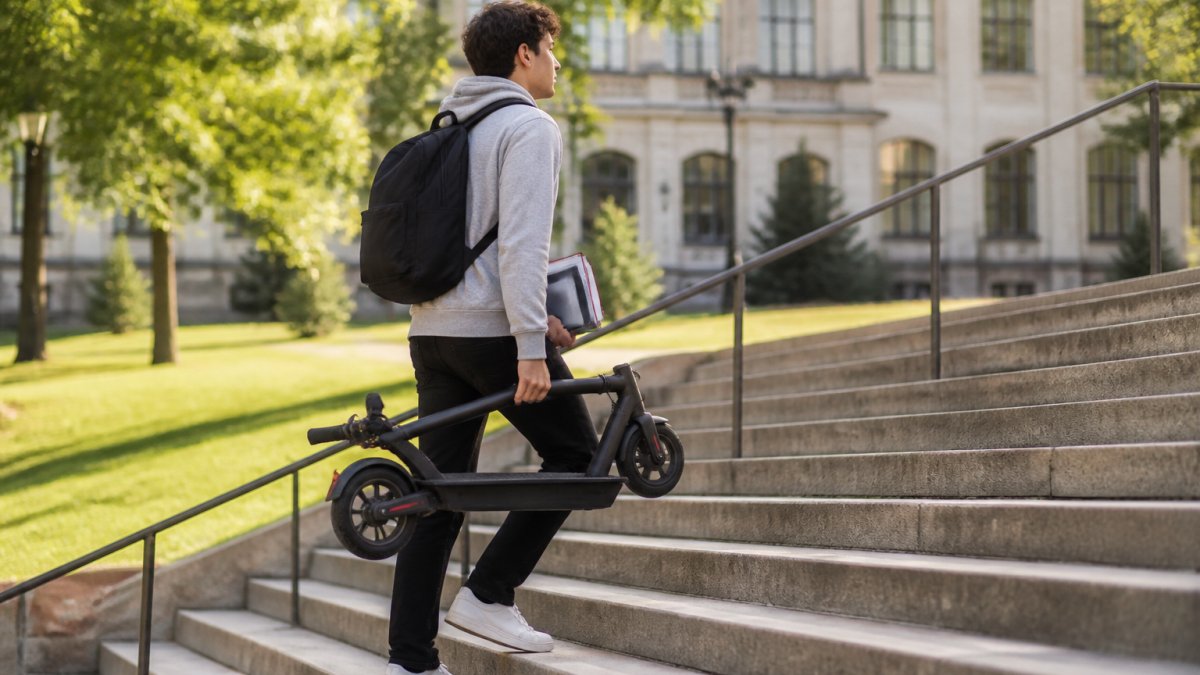
The DT08 at 48.5 pounds is the threshold. Some students handle it fine; others struggle carrying it more than a few steps.
The DT10 is a parking scooter. Don't buy it expecting to carry it between classes. It's designed for students who ride to a central campus location and leave it there, or who have dedicated storage space.
What "portability" really means for college: Can you carry it up one flight of stairs without strain? Can you store it in your dorm without taking up half the room?
Electric Scooter Campus Rules and Safe Riding Practices
Before you buy any scooter, check your specific campus's regulations. Rules vary dramatically between universities.
Many campuses restrict scooter riding to specific paths and prohibit them on main walkways where pedestrians are heavy. Some require helmets (always wear one anyway). Others ban them entirely on certain campus zones during peak hours. A few universities have banned scooters completely.
Your campus probably has rules about where you can park. Some require designated parking areas; others allow parking anywhere. Theft is real, secure your scooter or bring it indoors when you leave it unattended.
Safe riding on campus means treating pedestrians as your priority. Crowded paths require dismounting and walking. Slow down near building entrances and crosswalks. The electronic braking on DriveTron models responds quickly, which helps in sudden stops, but nothing beats riding defensively.
Visibility matters in early morning or evening classes. The DriveTron models don't include built-in lights, so add a front light and rear reflector if you're riding in low light. Wear bright clothing. Make yourself visible to other riders, pedestrians, and vehicles at campus entry points.
Electric Scooter vs Car Cost for College: Total Ownership Breakdown
The upfront cost of an electric scooter is just the beginning. Total cost of ownership includes charging, maintenance, potential repairs, and replacement parts.
Initial purchase: The DT01 costs $449.99, the DT08 costs $549.99, and the DT10 costs $749.99.
Electricity cost: Charging the DT01 from empty to full costs roughly a few cents per charge, depending on your local electricity rates.
Maintenance: The 10-inch tubeless tires on DriveTron models don't require air, eliminating the most common maintenance task on traditional scooters. Brake pads wear over time, but replacement is inexpensive. No oil changes, no transmission fluid, no engine maintenance.
Repairs: Tubeless tires are more durable than pneumatic ones, but they can still be damaged. Motor or battery issues are rare with quality engineering, but if they occur, repair costs are higher. Next Pair Rides ships from a U.S. warehouse with FedEx tracking.
Parking: Most campuses allow free scooter parking. No parking permit, no parking fees, no parking validation. Compare this to campus car parking, which often costs money.
Total annual cost for a student: Purchase a DT01 at $449.99 (one-time), add electricity at roughly $20 per year, and budget $50-100 for potential maintenance.
The real cost comparison isn't scooter vs car, it's scooter vs car vs walking vs public transit. For most college campuses, a scooter beats all three on speed, convenience, and cost.
Finding the right electric scooter college campus solution means matching the scooter's capabilities to your actual commute, not just buying the most powerful option.
Frequently Asked Questions
What is the best electric scooter for college campuses?
The best choice depends on campus size and distance. For short rides under 2 miles, the DriveTron DT01 ($449.99) offers portability at 40.8 lb and 19-25 mile range. Mid-size campuses benefit from the DT08 ($549.99) with 25-37 mile range and 48.5 lb weight. Large campuses with longer commutes need the DT10 ($749.99), which delivers 28-40 mile range with suspension for varied terrain. All three feature 10-inch tubeless tires and fit within standard 265 lb weight limits.
How far should an electric scooter go for a college commute?
Campus size determines your range requirement. Small campuses (under 1 mile between classes) need 15-20 miles minimum; the DT01 covers this with 19-25 mile estimated range. Medium campuses (1-3 miles) require 25+ miles; the DT08 provides 25-37 miles. Large university networks (3+ miles) demand 30+ mile capacity; the DT10 offers 28-40 miles. Remember that actual range varies with rider weight, terrain, weather, and battery condition, hills and cold weather reduce range by 15-25%.
Are electric scooters allowed on college campuses?
Campus rules vary significantly by institution. Most universities allow scooters on pathways but ban them from buildings, crowded pedestrian zones, and stairs. Check your campus transportation policy before purchasing. Common restrictions include speed limits in high-traffic areas, helmet requirements, and designated parking zones. Some campuses require registration or permits. Contact your student services or facilities office for specific electric scooter campus rules at your school to avoid fines or confiscation.
Can you really carry an electric scooter between classes?
Yes, but weight matters. The DT01 at 40.8 lb is carryable for short distances and fits in most lockers or under desks. The DT08 (48.5 lb) requires stronger grip or a carrying strap for stairs. All three feature foldable designs that reduce footprint, making them easier to store in dorm rooms or classrooms. For frequent stair climbing or long hallway carries, lighter scooters work better. If you're under 150 lb or have limited upper body strength, the DT01 is the most practical choice for classroom-to-classroom transport.