

Table of Contents
- Hub Motor vs Mid Drive Scooters: The Core Difference
- Hub Motor vs Mid Drive Efficiency and Range
- Best Motor for Hill Climbing Scooters: Torque and Gearing
- Weight Distribution, Handling, and Center of Gravity
- Electric Scooter Motor Maintenance: What Each Design Demands
- Cost of Ownership: Purchase Price vs Long-Term Repairs
- Which Setup Fits Your Ride? Use Cases Compared
- Frequently Asked Questions
Last Updated: September 28, 2026
Hub Motor vs Mid Drive Scooters: The Core Difference
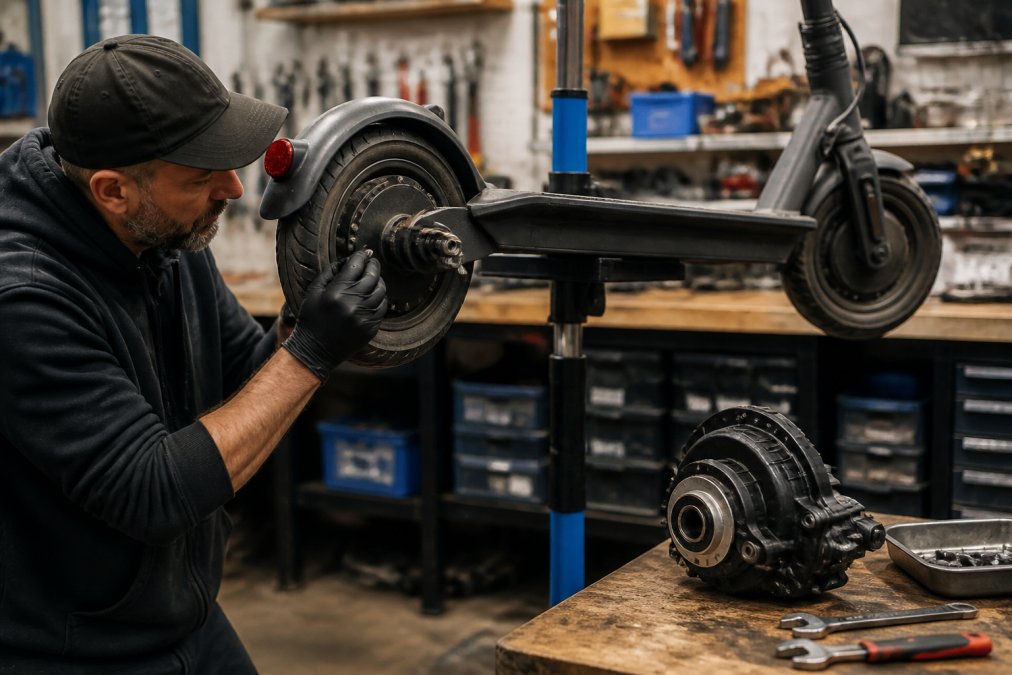
The difference between hub motor and mid drive scooters comes down to where the motor sits and how that placement changes everything else: power delivery, balance, maintenance, and cost. A hub motor lives inside the wheel itself. A mid-drive motor sits at the frame's center and drives the wheel through a belt or chain. That single design choice shapes how a scooter climbs, handles, and ages.
This guide breaks down the hub motor vs mid drive question the way a mechanic would, not a marketer.
How Hub Motors Work
A hub motor is a brushless DC motor built directly into the wheel's center. Power goes straight from the motor controller to the wheel with no chain, belt, or gearing in between.
How Mid-Drive Motors Work
A mid-drive motor mounts at the frame's center and sends power through a belt or chain to the rear wheel, often using the scooter's gearing.
Hub Motor vs Mid Drive Efficiency and Range
Efficiency and range are where the two designs diverge most, and the reason is mechanical, not marketing. A hub motor is a direct-drive or geared unit that spins at wheel speed. A mid-drive motor spins at its own rpm and sends power through a belt, chain, or gearbox to the wheel. That single difference in how power reaches the ground explains almost every range and efficiency claim you'll read.
Where hub motors lose efficiency
A direct-drive hub motor has one fixed gear ratio: the wheel. At low speed, the motor produces strong torque but operates below its most efficient rpm band. At high speed, back-EMF (the voltage the spinning motor generates against its own supply) rises, and the controller has to work harder to push current through. Both ends of the speed range cost you watt-hours.
Where mid-drive wins, and where it doesn't
A mid-drive motor can use the scooter's gearing (or a dedicated reduction) to keep the motor near its peak efficiency rpm across a wider speed range. On a stand-up scooter, this usually means a belt or chain driving the rear wheel through a fixed or variable reduction. The motor stays in its sweet spot whether you're crawling at 5 mph or cruising at 25 mph.
What actually determines your range
Motor type is a second-order factor. Range is dominated by:
- Battery capacity, watt-hours (voltage × amp-hours), not just voltage or amp-hours alone.
- Controller matching, a controller that limits current smoothly and doesn't dump heat will extract more usable energy from the same pack.
- Thermal management, a motor that overheats on a long climb will derate, forcing you to draw more current for the same speed and burning range.
- Rider weight, tire pressure, and terrain, the same scooter can lose 20-30% of its range with soft tires and a heavy rider on rolling hills.
Best Motor for Hill Climbing Scooters: Torque and Gearing
The best motor for hill climbing scooters is one that delivers high torque at low speed without overheating. Hub motors actually excel here because they produce maximum torque from a standstill, which is why many dual-motor scooters use two hub units for climbing ability.
Weight Distribution, Handling, and Center of Gravity
Weight distribution separates these two designs more than any spec sheet shows. A hub motor adds mass at the wheel, raising unsprung weight and pushing the center of gravity toward the rear or front depending on placement.
Electric Scooter Motor Maintenance: What Each Design Demands
Electric scooter motor maintenance looks very different depending on your drivetrain. Hub motors need almost nothing beyond occasional bearing checks and keeping water out of the wheel assembly.
- Hub motor: check bearings, inspect for water ingress, verify wiring connections
- Mid-drive: inspect belt or chain tension, check for wear, lubricate drivetrain, service gearing
- Both: keep the motor controller cool and connections dry
Cost of Ownership: Purchase Price vs Long-Term Repairs
Most comparisons stop at the sticker price. That's the least useful number. The real question is what each design costs you over three to five years of actual riding, and the answer flips depending on how you ride and how you maintain.
The upfront gap
Hub-motor scooters are cheaper to buy because the motor is a self-contained wheel assembly with no external drivetrain. Mid-drive scooters cost more upfront: the motor unit, the belt or chain, the gearing, and the frame geometry to support a center-mounted drive all add cost. That gap is real, but it's only the first line item.
Routine costs over 3-5 years
Here's where the two designs diverge in ways most buyers don't model:
Hub motor:
- Bearings: inspect annually, replace every 2-4 years depending on water exposure.
- Tires and tubes: the motor-in-wheel design makes tire changes harder, so many riders pay a shop. Budget for that labor.
- Water ingress: the most common killer. A corroded hub often means replacing the whole wheel assembly, not a $20 bearing.
- Controller and wiring: usually last the life of the scooter if kept dry.
Mid-drive:
- Belt or chain: replace every 1,500-3,000 miles depending on conditions. Chains stretch; belts wear and can snap.
- Gearing and cassette (if geared): wear items that need periodic replacement.
- Motor unit: usually sealed and long-lived, but if it fails, the repair is more involved than swapping a wheel.
- Tire changes: easier, because the wheel is standard. This is a real labor saving over 3-5 years if you ride a lot.
The hidden cost most buyers miss
The hub motor's hidden cost is the wheel assembly. When a bearing fails or water gets in, you often can't replace just the bearing, you replace the motor wheel. That's a single, larger expense that arrives without warning.
Which is cheaper over time?
There's no universal answer, but the pattern is consistent:
- Low-mileage, flat-route commuter: hub motor wins. Fewer wear parts, less routine service, and the wheel-assembly risk is low if you keep it dry.
- High-mileage, hilly, or off-road rider: mid-drive can win on total cost because the drivetrain is designed to be serviced in pieces, and tire changes are cheaper.
- Rider who ignores maintenance: hub motor wins by default, because there's less to ignore, until the wheel assembly fails.
| Factor | Hub Motor | Mid-Drive Motor |
|---|---|---|
| Upfront cost | Lower | Higher |
| Routine maintenance | Minimal | Regular drivetrain service |
| Tire changes | Harder (motor in wheel) | Easier (standard wheel) |
| Common failure | Bearings, water damage | Belt/chain wear, gearing |
| Failure cost pattern | One large hit (wheel assembly) | Many small hits (wear items) |
| Best for | Low-mileage commuters, budget riders | High-mileage, hilly, or off-road riders |
Which Setup Fits Your Ride? Use Cases Compared
Your route decides this more than any spec. Hub motors suit flat, stop-start commutes where simplicity and low maintenance matter most. Mid-drive suits riders facing long climbs or who want geared efficiency.
Frequently Asked Questions
What is the main performance difference between a hub motor and a mid-drive motor?
Hub motors sit inside the wheel and push it directly, so they deliver instant throttle response and simple acceleration. Mid-drive motors sit at the cranks and send power through the drivetrain, using gear ratios to multiply torque. That gearing makes mid-drive setups better at sustained climbing and balancing power across speeds, while hub motors feel quicker off the line and need fewer moving parts.
Why do most electric scooters use hub motors instead of mid-drive?
Hub motors are cheaper to manufacture, easier to seal against water and dust, and require almost no drivetrain maintenance. There is no chain, cassette, or derailleur to wear out. For the short, flat urban trips most scooters handle, a hub motor delivers enough torque and range without the extra cost and complexity of a crank-driven system, which is why it dominates the scooter market.
Are mid-drive motors more efficient for climbing steep hills?
Mid-drive motors gain a mechanical advantage by running through the bike's gears, so they can climb steep grades at lower motor stress and often better efficiency. Hub motors handle moderate hills well but can overheat or lose power on long, steep inclines because they cannot change gear ratio. For hilly terrain, gearing matters more than raw wattage.
What are the primary maintenance differences between hub and mid-drive systems?
Hub motors have very few wear items: mostly bearings and wiring, with no chain or cassette to service. Mid-drive systems wear the chain, cassette, and derailleur faster because motor torque runs through them, so expect more frequent chain replacement and drivetrain checks. Hub motors win on serviceability, while mid-drive setups reward riders willing to keep up with drivetrain maintenance.
Choosing between a hub motor and a mid drive scooter is really a question about your daily route, not a spec sheet. If you want simple ownership and reliable power for city riding, a hub-motor scooter is the practical choice. Next Pair Rides stocks hub-motor models with dual-motor options, 10-inch tubeless tires, and battery capacities built for real commutes. Browse the lineup and find the scooter that fits how you actually ride.